



ElectroGuard® Energy Isolation System – Electric, Pneumatic, Hydraulic
 Product Catalog
- Helps reduce workplace injuries resulting from complicated Lockout/Tagout procedures
- A cost-effective solution to conform with OSHA requirements for control of hazardous energy
- Simplifies operator Lockout/Tagout procedures to help improve productivity
- Modular, pre-wired for quick installation
- Higher cycle life than mechanical disconnects, for reduced downtime
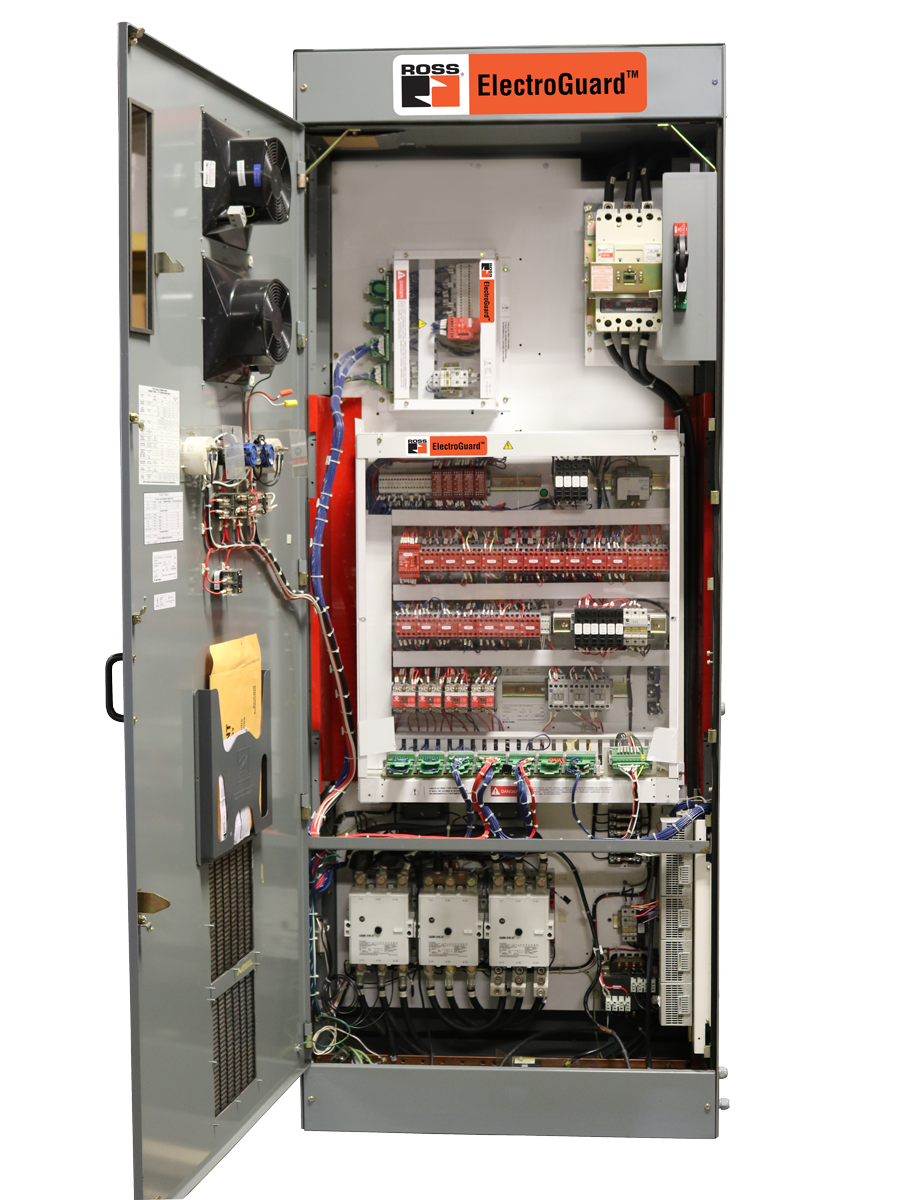
The ElectroGuard system brings a new standard for hazardous energy isolation. Greatly easing the task of the machine operator or maintenance personnel to properly perform Lockout/Tagout procedures can offer greater assurance of compliance, with the added value of improved productivity. As a standard, ElectroGuard systems include low-voltage Remote Lockout Stations and a Main Control Panel, factory-sealed and certified to Category 4 / PL e, with options for Pneumatic and Hydraulic isolation to provide the complete solution in a flexible, maintainable, cost-effective system.
loading...
loading...
Product Overview
The ROSS Controls ElectroGuard system is a comprehensive, pre-engineered energy isolation solution that integrates electrical, pneumatic, and hydraulic energy isolation into a single factory-sealed and certified system. By centralizing all energy isolation functions and providing low-voltage remote lockout stations (RLS) at each machine access point, ElectroGuard dramatically simplifies the lockout/tagout (LOTO) procedure for machine operators and maintenance personnel, improving compliance and reducing the time required to perform safe isolation.
The standard ElectroGuard system includes a Main Control Panel that houses the electrical isolation contactor assembly, safety PLC-based control logic, pneumatic isolation valve (optional), and hydraulic isolation valve (optional). Remote Lockout Stations powered by low-voltage 24 VDC from the Main Control Panel are located at each machine access point. When an operator requires access, they operate the low-voltage RLS rather than physically traveling to the main electrical panel and operating a high-voltage disconnect switch, eliminating the arc flash hazard associated with operating main electrical disconnects under load.
ElectroGuard systems are factory-sealed and certified to Safety Category 4 / PL e per ISO 13849-1, the highest functional safety performance level. The system's redundant, self-monitoring architecture detects faults in the isolation contactors, voltage sensing circuits, and grounding contactor before they can result in a loss of the safety function. The grounding contactor feature connects isolated electrical lines to a dedicated isolated ground after isolation is verified, providing protection against capacitive coupling, inertial regeneration, and other sources of residual voltage.
ElectroGuard systems are available in single-zone and multi-zone configurations. Single-zone systems support up to 6 Remote Lockout Stations (or up to 13 with an external RLS Interface Panel). Multi-zone systems support up to 8 independently controlled zones with 69 total RLS stations and 32 energy source isolation points per system. Multi-zone capability enables personnel to lock out only the specific machine zone they need to access rather than shutting down the entire machine, significantly improving production throughput.
Key Engineering Features
- Integrated Multi-Energy Isolation - Isolates electrical energy (208 to 600V AC, 43 to 1250A), pneumatic energy (30 to 120 psig), and hydraulic energy (up to 5000 psig) in a single system with a unified operator interface. Eliminates the need for separate lockout procedures for each energy type.
- Category 4 / PL e Safety Certification - Factory-sealed and certified to ISO 13849-1 Safety Category 4, Performance Level e, the highest achievable functional safety level. The system architecture is redundant and self-monitoring, with faults detected before they can result in an unexpected machine startup.
- Remote Lockout Stations at Access Points - Low-voltage (24 VDC) Remote Lockout Stations are located at each machine access point, allowing operators to initiate and verify isolation without traveling to a main electrical panel. Operators switch a low-power device without exposure to the arc flash hazard of high-voltage disconnects.
- System Isolated Status Indication - A System Isolated indicator light on each Remote Lockout Station provides positive confirmation that all energy sources controlled by the ElectroGuard system have been verified as isolated. This positive indication eliminates reliance on operator assumption or verbal confirmation.
- Grounding Contactor for Residual Energy Protection - After electrical isolation is verified, the grounding contactor connects the isolated lines to a dedicated isolated ground, providing protection against capacitive coupling from adjacent energized conductors, inertial regeneration from motors, and other sources of residual voltage that could cause injury after isolation.
- Ground Loss Monitor - Continuously monitors the integrity of the system protective ground. Detects loss of system ground, which could compromise the effectiveness of the grounding contactor function. Ground loss is detected as a system fault, preventing false confirmation of safe isolation.
- Redundant, Self-Monitoring Control Architecture - Safety PLC-based control logic monitors all isolation contactors, voltage sense circuits, grounding contactors, and pressure sensors on pneumatic and hydraulic isolation modules. Faults are detected in time to prevent loss of the safety function, satisfying Category 4 / PL e diagnostic coverage requirements.
- Multi-Zone Capability - Multi-zone systems allow up to 8 independent isolation zones with up to 69 Remote Lockout Stations total, enabling zone-level isolation. Personnel access only the zone they need, while other machine zones remain operational, significantly reducing LOTO-related downtime.
- Higher Cycle Life than Mechanical Disconnects - Electrical isolation uses contactors rather than mechanical rotary disconnect switches, providing dramatically longer cycle life. LOTO events that occur dozens of times per shift wear mechanical disconnects rapidly; contactor-based isolation eliminates this maintenance burden.
- Modular, Pre-Wired Factory-Sealed Design - All system panels are factory assembled, wired, and tested before shipment. Modular design enables quick installation with minimal field wiring. Factory-sealed panels maintain system integrity and provide tamper evidence for ongoing compliance verification.
- Single-Point Lockout/Tagout - Isolates electrical, pneumatic, and hydraulic energy simultaneously from a single operator action at the Remote Lockout Station, reducing lockout time by up to 70 seconds compared to traditional multi-point LOTO procedures. Studies show SPLO systems reduce jam clearance time significantly, improving uptime.
Technical Specifications
General Specifications
| Parameter | Specification |
| Safety Certification | Category 4 / PL e per ISO 13849-1:2015 |
| Standards Conformity | UL 508A with cULus listing; OSHA 1910.147; ISO 13849-1 Category 4 / PL e; Conformity to industry standards |
| Electrical Isolation Voltage Range | 208 to 600V AC, 50/60 Hz |
| Electrical Isolation Current Range | 43 to 1250 A |
| Pneumatic Isolation Pressure Range | 30 to 120 psig (2 to 8 bar) |
| Pneumatic Isolation Valve Port Size | 3/4 or 1 inch valve port |
| Hydraulic Isolation Pressure Range | 500 to 5000 psig (35 to 344 bar) |
| Hydraulic Isolation Valve Port Size | 1 inch valve port |
| Remote Lockout Station Voltage | 24 VDC, supplied from ElectroGuard Main Control Panel |
| Expansion Module Voltage | 24 VDC, supplied from ElectroGuard Main Control Panel |
| Enclosure Ratings | NEMA Type 1, 4, or 12 |
| Enclosure Styles | Wall-mount or free-standing MCC-style enclosure |
| Single-Zone RLS Capacity | Up to 6 RLS stations standard; up to 13 with external RLS Interface Panel |
| Multi-Zone RLS Capacity | Up to 69 RLS stations (Base + 7 RIP) |
| Multi-Zone Energy Source Capacity | Up to 32 energy sources (combination of EIP, PIP, and HIP modules) |
| Control Architecture | Safety PLC-based with HMI for advanced diagnostics and troubleshooting |
Temperature Ratings
ElectroGuard system panels are designed for indoor industrial environments. Enclosure NEMA Type rating determines the level of environmental protection.
| Configuration | Ambient Temperature | Media Temperature |
| Panel Operating Temperature (NEMA 1/12) | 0 to 40 C (32 to 104 F) typical indoor industrial | |
| RLS Operating Temperature | 0 to 40 C (32 to 104 F) typical industrial |
Important: The ElectroGuard system electronics are not rated for outdoor installations without appropriate environmental enclosure upgrades. Contact ROSS Controls for outdoor or extreme-temperature installations.
Certifications & Compliance
| Certification/Standard | Detail |
| ISO 13849-1 Category 4 / PL e | Factory-sealed and certified to the highest functional safety performance level. Category 4 requires redundant architecture with cross-fault monitoring and the ability to detect faults before they can result in a loss of the safety function. |
| UL 508A (cULus Listing) | Panel assemblies conform to UL 508A Industrial Control Panel standard with cULus listing, satisfying North American electrical safety requirements for industrial panel assemblies. |
| OSHA 1910.147 | Designed to conform to OSHA 1910.Subpart J Control of Hazardous Energy (Lockout/Tagout) requirements. The ElectroGuard system can be used as part of an alternative lockout method per ANSI Z244.1 when properly integrated with defined procedures. |
| ANSI Z244.1 | Supports both traditional LOTO and alternative lockout methods per ANSI Z244.1:Control of Hazardous Energy. Multi-zone capability enables machine zone-level isolation for alternative method compliance. |
| IEC 61508 SIL | Redundant, self-monitoring safety architecture supports SIL 3 qualification when properly documented per IEC 61508. Safety data available from ROSS Controls upon request. |
| CE Marking | Available for EU market installations. ElectroGuard systems can be configured and documented for CE marking per the EU Machinery Directive and Low Voltage Directive. |
Typical Applications & Industries
Automotive Manufacturing
- Body shop robotic welding cells where multiple energy sources (electrical, pneumatic, and hydraulic) must be isolated before robotic maintenance, teach pendant programming, or fixture change. ElectroGuard enables zone-level isolation of specific robot cells while adjacent cells continue production.
- Stamping press lines with multiple presses where maintenance access to an individual press requires isolation of that press's electrical, pneumatic, and hydraulic energy without stopping the entire transfer line.
- Paint shop conveyors and automated systems where frequent maintenance access is required and traditional LOTO procedures cause unacceptable downtime. ElectroGuard's single-point lockout reduces access time significantly.
- Assembly line hydraulic fixture circuits combined with pneumatic tooling and electrical robot interfaces requiring simultaneous multi-energy isolation at zone level for routine maintenance and setup changes.
Steel and Metals Processing
- Steel mill rolling mill stands with complex electrical, pneumatic, and hydraulic energy circuits. ElectroGuard's multi-zone capability allows isolation of individual rolling stands while others remain in service, reducing LOTO-related production downtime.
- Continuous casting machine hydraulic and electrical circuits requiring frequent zone-level isolation for roller replacement, spray bar maintenance, and straightener segment work.
- Aluminum and steel processing line hydraulic shears, pinch rolls, and tension bridles with multiple energy types requiring simultaneous isolation before maintenance access.
Machine Tools and Metalworking
- CNC machining centers with hydraulic clamping, pneumatic chip clearing, and electrical servo drives. ElectroGuard provides single-point isolation for all three energy types before entering the machining zone for setup or maintenance.
- Transfer lines with multiple stations requiring zone-level isolation. Different maintenance personnel can access different stations simultaneously using multi-zone ElectroGuard configurations.
- Large grinding and honing machines with hydraulic table drives, pneumatic cooling, and electrical axis drives requiring integrated isolation for dressing operations and wheel change.
Plastics and Chemical Processing
- Plastic injection molding machines with electrical, hydraulic, and pneumatic energy requiring full or partial isolation for mold change, purging, and screw maintenance.
- Extrusion lines with multiple independently isolable zones where operators need access to specific sections (die, screen changer, pelletizer) without shutting down the entire line.
- Chemical process equipment with pneumatic and hydraulic valve actuators plus electrical drives requiring integrated isolation before maintenance on actuators, valves, or drives in hazardous process environments.
Food and Beverage Processing
- Food processing lines requiring frequent sanitation shutdowns with simultaneous isolation of electrical drives, pneumatic conveyors, and hydraulic forming equipment. ElectroGuard's single-point lockout is especially valuable where rapid line access for sanitation is critical.
- Packaging lines with pneumatic, hydraulic, and electrical energy where multiple operators may need simultaneous access to different line sections, requiring individual RLS stations at each access point.
- Brewing, distilling, and bottling equipment with complex multi-energy circuits requiring standardized isolation procedures across similar machine types throughout a facility.
General Assembly and Discrete Manufacturing
- Assembly automation with pneumatic and electrical energy sources where operators need frequent access for part loading, jam clearing, and tooling change. ElectroGuard's low-voltage RLS eliminates the arc flash hazard of traditional disconnect operation.
- High-density production areas where multiple machines share adjacent footprints and LOTO procedures must be clear, machine-specific, and quickly executable to minimize production impact.
- Facilities standardizing their LOTO system across multiple machine types to reduce operator training burden and improve procedural consistency.
Ordering and Model Number Configuration
ElectroGuard systems are custom-configured based on the electrical current rating, number of energy sources, number of Remote Lockout Stations, zone configuration, and enclosure type. Contact ROSS Controls for system design and quoting.
|
ElectroGuard System Configuration Parameters:
ELECTRICAL ISOLATION MODULE (EIP) Voltage: 208 to 600V AC, 50/60 Hz Current: 43, 85, 200, 400, 600, 800, 1000, 1250 A
PNEUMATIC ISOLATION MODULE (PIP) Pressure: 30 to 120 psig (2 to 8 bar) Port Size: 3/4 inch or 1 inch valve port
HYDRAULIC ISOLATION MODULE (HIP) Pressure: 500 to 5000 psig (35 to 344 bar) Port Size: 1 inch valve port
REMOTE LOCKOUT STATION (RLS) Single-zone: up to 6 (13 with RLS Interface Panel) Multi-zone: up to 69 per system
ZONE CONFIGURATION Single-zone: 1 zone, up to 6 energy sources Multi-zone: up to 8 zones, up to 32 energy sources
ENCLOSURE NEMA Type 1, 4, or 12 Wall-mount or free-standing MCC-style
Contact ROSS Controls at (800) 438-7677 for system configuration, application review, and quotation. |
ElectroGuard systems are factory-assembled, wired, and tested before shipment. Provide ROSS Controls with the machine electrical current draw, number of energy sources to be isolated, number and location of access points, and zone requirements for system design.
Selectable time delay (1 to 30 seconds adjustable) is available for applications requiring a defined delay between isolation command and confirmation of safe state.
Branch circuit protection options include no protection (incoming line lugs only), fusible disconnect, or circuit breaker depending on the installation requirements.
Remote Lockout Stations support both top and bottom conduit entry, rotary lockable disconnect or trapped key options, and white or green isolation status indicator lights.
For multi-zone systems, contact ROSS Controls for the Output Control Panel (OCP) and Remote Lockout Station Interface Panel (RIP) configuration required for the specific application.
ElectroGuard systems are compatible with integration of ROSS DM2 pneumatic safety valves for pneumatic isolation and ROSS HBB hydraulic safety valves for hydraulic isolation, providing a complete ROSS-engineered multi-energy isolation solution.
Accessories
Pneumatic Isolation Module (PIP)
Optional module for pneumatic energy isolation integrated into the ElectroGuard Main Control Panel. Includes safety-rated pneumatic valve and redundant pressure sensors to verify isolation. Operates at 30 to 120 psig with 3/4 or 1 inch port options. Controlled and monitored by the ElectroGuard safety PLC.
Hydraulic Isolation Module (HIP)
Optional module for hydraulic energy isolation integrated into the ElectroGuard Main Control Panel. Includes hydraulic isolation valve and redundant pressure sensors to verify isolation. Rated to 5000 psig with 1 inch port. Controlled and monitored by the ElectroGuard safety PLC.
RLS Interface Panel (RIP)
Expands single-zone capacity from 6 to 13 Remote Lockout Stations. Required for multi-zone systems to add additional RLS stations to each zone beyond the base panel capacity. Each RIP supports additional RLS connections and is powered from the Main Control Panel.
Output Control Panel (OCP)
Multi-zone expansion module adding additional energy source isolation capacity. Each OCP adds 4 energy source outputs. Used in multi-zone configurations to reach the maximum of 32 energy sources per system.
HMI Display
Human-machine interface display on the Main Control Panel provides system status overview, fault diagnostics, cycle count data, and lockout/tagout event logging. Enables maintenance personnel to diagnose system faults and document LOTO events for regulatory recordkeeping.
Related Products & Accessories
- e L-O-X Electrical Isolation Devices - Standalone local electrical energy isolation device with lockable disconnect, 3-phase power indicator, and start/stop buttons for individual machine-level LOTO. https://www.rosscontrols.com/en/series/1315-electrical-isolation-devices
- HBB Series Hydraulic Block & Bleed Valves - Electrically operated redundant hydraulic block and bleed valve systems for integration as hydraulic isolation elements in ElectroGuard or standalone safety systems. https://www.rosscontrols.com/en/series/1311-hbb
- Hydraulic L-O-X Lockout Valve - Manual hydraulic lockout valve for OSHA-compliant hydraulic energy isolation in applications not requiring integrated multi-energy systems. https://www.rosscontrols.com/en/series/3133-hydraulic-lockout-valve
- 15 Series Pneumatic Lockout L-O-X Valves - Manual pneumatic lockout valves for standalone pneumatic energy isolation per OSHA 1910.147. https://www.rosscontrols.com/en/series/1287-lockout-valves-15-series
- DM2 Series Pneumatic Double Valves - Control-reliable pneumatic double valves for Category 4 / PL e safe exhaust applications, integrating with ElectroGuard pneumatic isolation modules. https://www.rosscontrols.com/en/categories/529-hydraulic
Frequently Asked Questions (FAQ)
Q: What makes ElectroGuard different from traditional lockout/tagout?
A: Traditional LOTO requires operators to physically travel to each energy source (main electrical panel, pneumatic valve, hydraulic valve), operate each one individually, and apply personal padlocks at each location. ElectroGuard centralizes isolation into a single system where all energy sources are isolated simultaneously from a low-voltage Remote Lockout Station located at the access point. This eliminates travel time, reduces arc flash exposure from high-voltage disconnect operation, and provides positive confirmation of isolation through the System Isolated indicator.
Q: What safety category is ElectroGuard certified to?
A: ElectroGuard is factory-sealed and certified to Category 4 / Performance Level e (PL e) per ISO 13849-1:2015, the highest achievable functional safety performance level for machinery. The system architecture is redundant and self-monitoring, with faults detected before they can result in a loss of the safety function.
Q: Can ElectroGuard isolate electrical, pneumatic, and hydraulic energy simultaneously?
A: Yes. The standard ElectroGuard system includes the Electrical Isolation Module and optional Pneumatic Isolation Module (PIP) and Hydraulic Isolation Module (HIP). When all three modules are included, a single operator action at the Remote Lockout Station initiates simultaneous isolation of all three energy types. The System Isolated indicator confirms all sources are verified as isolated before the padlock is applied.
Q: What voltage and current ranges does ElectroGuard cover?
A: ElectroGuard supports electrical isolation from 208 to 600V AC (50/60 Hz) with current ratings from 43 to 1250 amperes, covering the full range of typical industrial machine voltage and current requirements.
Q: What is a Remote Lockout Station?
A: A Remote Lockout Station (RLS) is a compact, low-voltage (24 VDC) device mounted at a machine access point. It includes an isolation switch, a System Isolated indicator light, and a padlock hasp. The operator commands isolation from the RLS, waits for the System Isolated light, then applies their personal padlock before entering the machine. The low-voltage RLS eliminates the arc flash hazard of operating a main high-voltage electrical disconnect.
Q: How many Remote Lockout Stations can a single system support?
A: A single-zone ElectroGuard system supports up to 6 RLS stations standard, expandable to 13 with an external RLS Interface Panel. Multi-zone systems support up to 69 RLS stations total across up to 8 independently controlled zones.
Q: What is the purpose of the grounding contactor?
A: After electrical isolation is verified (voltage dropped to near zero on all phases), the grounding contactor connects the isolated electrical lines to a dedicated isolated ground. This protects against residual voltage sources including capacitive coupling from adjacent energized conductors, regenerative back-EMF from motor windings, and capacitor discharge from variable frequency drives. The isolated ground is separate from the facility ground to prevent interaction with other circuits.
Q: Can ElectroGuard be used for multi-zone applications where different zones must be independently isolable?
A: Yes. Multi-zone ElectroGuard systems support up to 8 independently controlled zones. Different personnel can lock out different zones simultaneously using their individual RLS stations for their respective zones. This enables one crew to access Zone 1 for maintenance while production continues in Zones 2 through 8, dramatically improving machine uptime compared to whole-machine LOTO.
Q: How is ElectroGuard different from simply installing a single electrical disconnect?
A: A single electrical disconnect only isolates electrical energy and does not address pneumatic or hydraulic energy. It requires personnel to travel to the disconnect location and exposes them to arc flash hazards. ElectroGuard isolates all energy types simultaneously, provides positive verification of isolation, uses low-voltage RLS to eliminate arc flash exposure, supports multiple lockout stations per zone, and provides fault detection and status communication capabilities that a simple disconnect cannot provide.
Q: What is the selectable time delay feature?
A: The selectable time delay (1 to 30 seconds, adjustable) provides a defined period between the operator's isolation command and the system confirming the safe isolated state. This allows time for machine motion to come to a complete stop, drives to decelerate to zero speed, and pressures to equalize before isolation is confirmed. The delay is programmed during system commissioning based on the machine's stopping time characteristics.
Q: Does ElectroGuard require custom engineering for each installation?
A: ElectroGuard systems are application-specific and require ROSS Controls engineering involvement to define the electrical current rating, number of zones, number of RLS stations, energy source types, and enclosure configuration. ROSS Controls provides factory-assembled, pre-wired, and pre-tested panels. The customer provides dimensional information for the main panel and RLS mounting locations and the machine's electrical, pneumatic, and hydraulic interface connection data.
Q: How does the pneumatic isolation module work?
A: The Pneumatic Isolation Module includes a safety-rated pneumatic valve that closes when isolation is commanded, blocking the pneumatic supply to the machine. Redundant pressure sensors on the downstream side of the valve verify that pneumatic pressure has dropped below a safe threshold before the ElectroGuard control system confirms pneumatic isolation is complete. The verification signal is integrated with the System Isolated indicator so the operator does not receive isolation confirmation until pneumatic energy is verified as zero.
Installation & Maintenance Guidelines
- Engage ROSS Controls engineering early in the machine design or retrofit process. ElectroGuard systems require application-specific configuration based on the machine's electrical, pneumatic, and hydraulic energy sources and access points.
- Identify all energy sources that will be controlled by the ElectroGuard system (electrical circuits, pneumatic supply lines, hydraulic circuits) and provide this information to ROSS Controls for system sizing.
- Locate the Main Control Panel in an electrical room or panel enclosure accessible to qualified electrical personnel for installation, commissioning, and maintenance of the high-voltage electrical isolation components.
- Locate Remote Lockout Stations at every machine access point from which personnel could enter a hazardous area. Each RLS should be within arm's reach of the access gate, door, or opening it protects.
- Route Remote Lockout Station cabling from the Main Control Panel to each RLS location. All RLS cabling carries only 24 VDC from the Main Control Panel, eliminating the need for high-voltage conduit at RLS locations.
- For pneumatic isolation, connect the Pneumatic Isolation Module's valve ports to the main pneumatic supply line feeding the machine zone. Locate the isolation valve upstream of all pneumatic actuators in the zone.
- For hydraulic isolation, connect the Hydraulic Isolation Module's valve ports to the main hydraulic supply line feeding the machine zone. Ensure the isolation valve can safely handle the full system flow without exceeding the 5000 psig rating.
- Commission the system with qualified personnel. Verify that each RLS correctly initiates isolation, that the System Isolated indicator only illuminates after all energy sources are confirmed at zero, and that each energy source is correctly isolated at the monitored points.
- Document the ElectroGuard system configuration, including energy source types, isolation point locations, zone assignments, and RLS locations in the machine safety file and LOTO procedure documentation.
- Train all operators and maintenance personnel on ElectroGuard operation before production startup. Ensure each person understands the RLS lock application procedure, the meaning of the System Isolated indicator, and the proper sequence for isolating and restoring energy.
Warranty & Global Support
ROSS Controls provides a one-year warranty on all products, covering defects in material and workmanship from the date of purchase.
Global technical support is available through ROSS Controls offices in the USA (headquarters in Ferndale, Michigan), Canada, Brazil, Germany, France, United Kingdom, India, China, and Japan.
Contact ROSS Controls USA at +1-248-764-1800 or (800) 438-7677, or visit rosscontrols.com for ElectroGuard system design, application review, quotation, and technical support.
On-site commissioning support and operator training services are available from ROSS Controls. Contact your ROSS Controls representative for details on application engineering and training services.
Download Catalog: https://www.rosscontrols.com/en/series/1314-electroguard
Download Documents
ElectroGuard®