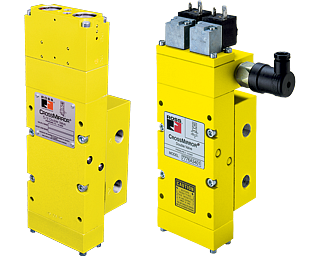




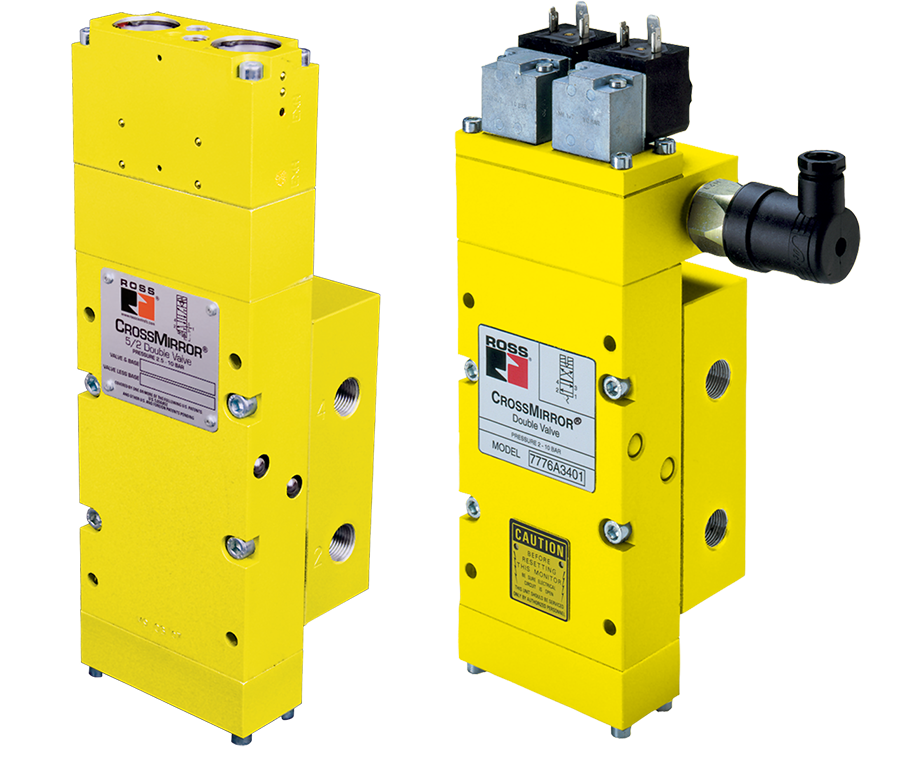
77 Series Double Valve Safety Category. 4 PL e, Internal Monitoring, Automatic Reset
 Installation Instructions
Product Catalog
Installation Instructions
Installation Instructions
Product Catalog
- Self-contained dynamic monitoring system requires no additional valve monitoring controls
- Automatic reset upon de-actuation
- Dual stainless steel spools construction
- Status indication switch (ready-to-run) to inform machine controller of valve condition
- The Pressure switch provides a signal when valve is in a faulted position
- SISTEMA Library available for download
loading...
loading...
Product Overview
The ROSS Controls 77 Series Double Valve is a pressure-controlled, self-monitoring safety valve that achieves Safety Category 4, Performance Level e (PL e) per ISO 13849-1 and Safety Integrity Level 3 (SIL 3) per IEC 61508 through its self-contained internal dynamic monitoring system. Unlike externally monitored double valves, the 77 Series requires no additional monitoring controller - all fault detection and valve inhibit logic is contained within the valve assembly itself.
The 77 Series operates as a 4-way double valve controlled by two separate pneumatic pilot signals in an 'AND' gate configuration. Both pilot signals must be applied within approximately 500 milliseconds of each other for the valve to actuate. This simultaneous actuation requirement makes the 77 Series particularly well-suited for two-hand control applications on pneumatically operated presses, valve operators, and safety latches, where simultaneous operator hand engagement is required before machine motion is permitted.
Constructed with precision stainless steel spools as the main valve elements, the 77 Series monitors spool positions dynamically during each cycle. If both pilot signals are not applied within the 500-millisecond discordance window, or if either spool valve actuates abnormally, inlet pressure is not routed to the actuating output port (port 4). Instead, pressure is maintained at port 2 (cylinder retracted) to return the actuator to its safe home position.
An integrated pressure switch provides a ready-to-run status signal to the machine controller, indicating whether the valve is in condition to accept the next actuation command. The 77 Series also carries DGUV, CE, CSA/UL, and EAC certifications and provides automatic reset upon de-actuation - the valve returns to its ready-to-run state without manual intervention after each normal cycle or after a fault that resolves on de-actuation.
Key Engineering Features
- Self-Contained Internal Dynamic Monitoring - All fault detection logic is built into the valve assembly. No external safety PLC, safety relay, or monitoring controller is required to achieve Category 4 PL e. This simplifies safety circuit design and reduces system component count.
- AND Gate Pneumatic Pilot Control - Two separate pneumatic pilot signals must be applied within approximately 500 milliseconds of each other to actuate the valve output. This simultaneous actuation requirement is the mechanical basis for two-hand control safety on press applications.
- 500-Millisecond Discordance Window - If both pilot signals are not applied within 500 milliseconds of each other, the valve does not actuate and maintains port 2 output (cylinder retract) as the safe state. This window is fixed by the valve's internal monitoring mechanism.
- Precision Stainless Steel Spool Construction - Main valve elements are manufactured from precision stainless steel spools in aluminum spool-and-sleeve housings, providing durability, corrosion resistance, and consistent spool position throughout the valve service life.
- Automatic Reset Upon De-actuation - The 77 Series resets automatically to its ready-to-run state when both pilot signals are removed. No manual reset button or external reset signal is required after a normal cycle or after a fault that clears on de-actuation.
- Integrated Pressure Switch (Status Indicator) - Optional integrated pressure switch provides an electrical ready-to-run status signal to the machine controller, informing it whether the valve is in a faulted state or ready to accept the next actuation command.
- Safety Category 4 PL e, SIL 3 - Achieves the highest available safety performance ratings for pneumatic double valves per ISO 13849-1 and IEC 61508 through its self-contained monitoring architecture.
- DGUV, CE, CSA/UL, and EAC Certified - Full international certification portfolio including DGUV (German Social Accident Insurance) certification required for press safety compliance in Germany and European markets.
- SISTEMA Library Available - Published SISTEMA safety data library available for download to support ISO 13849-1 PL verification and machine safety documentation.
- Base Mounted with Built-In Silencer - Base-mounted installation with integrated exhaust silencer on all models. Available in 1/2 inch and 3/4 inch port sizes with NPT or G thread options.
Technical Specifications
General Specifications
| Parameter | Specification |
| Series | 77 |
| Valve Function | 4-way double valve; AND gate pressure (pneumatic pilot) control |
| Construction | Double Spool and Sleeve (stainless steel spools) |
| Actuation | Pneumatic (pressure-controlled) or Electrical (solenoid-controlled) |
| Monitoring | Internal (self-contained dynamic monitoring system) |
| Status Indicator | Integrated pressure switch (ready-to-run indicator); included or not included depending on model |
| Status Indicator Connection | EN 175301-803 Form A |
| Solenoid Connection Type (Electrical Models) | EN 175301-803 Form A |
| Voltage (Electrical Models) | 24 VDC; 110/120 VAC |
| Base Size | Size 4 |
| Inlet Port Size | 1/2 inch (NPT) or 3/4 inch (G) |
| Outlet Port Size | 1/2 inch (NPT) or 3/4 inch (G) |
| Exhaust | Built-in silencer |
| Thread Types | NPT and G (BSPP) |
| Discordance Window | Approximately 500 milliseconds (both pilot signals must be applied within this window) |
| Operating Pressure Max (Pneumatic Models) | 100 psi (7 bar) |
| Operating Pressure Max (Electrical Models) | 150 psi (10.3 bar) |
| Reset | Automatic (upon de-actuation) |
| Mounting | Base mount |
| Ambient Temperature Range | 40 to 122 F (4 to 50 C) |
| Media Temperature Range | 40 to 175 F (4 to 80 C) |
| Flow Media | Filtered air |
| Valve Body Material | Cast aluminum |
| Spool Material | Stainless steel |
| Seal Material | Buna-N and Fluorocarbon |
| Safety Category | Category 4 |
| Performance Level | PL e |
| Safety Integrity Level | SIL 3 |
Flow Performance Data
Flow coefficient data for 77 Series double valves. Base size 4 for all models. Pneumatic actuation models: 100 psi max; electrical models: 150 psi max.
| Model Suffix | Cv (1-2) | Cv (1-4) | Cv (2-3) | Cv (4-5) | Length | Width | Height | Weight |
| NPT, 1/2" Ports, No Status Switch | 3.2 | 3.4 | 2.7 | 7.2 | 4.25 in (108.0 mm) | 4.11 in (104.4 mm) | 11.92 in (302.9 mm) | 10.6 lb (4.8 kg) |
| G, 3/4" Ports, With Status Switch | 3.2 | 3.4 | 2.7 | 7.2 | 6.87 in (174.4 mm) | 4.88 in (124.0 mm) | 12.17 in (309.0 mm) | 11.2 lb (5.1 kg) |
Certifications & Compliance
| Certification/Standard | Detail |
| Safety Category | Category 4 per EN ISO 13849-1:2015, achieved through self-contained internal monitoring. |
| Performance Level | PL e per EN ISO 13849-1:2015 - the highest performance level for machinery safety. |
| Safety Integrity Level | SIL 3 per IEC 61508 - the highest safety integrity level for pneumatic valve applications. |
| DGUV Certification | German Social Accident Insurance certification required for press safety circuit compliance in Germany and many European markets. |
| CE Marking | CE certified for EU Machinery Directive compliance. |
| CSA/UL Certification | North American electrical and safety certification. |
| EAC Declaration | Eurasian Conformity Declaration for markets requiring EAC certification. |
| SISTEMA Library | Published SISTEMA safety data library available for ISO 13849-1 PL verification and circuit documentation. |
Typical Applications & Industries
Two-Hand Control for Pneumatic Power Presses
- Primary safety control valve for pneumatic clutch/brake systems on air-operated power presses where two-hand operator control is mandated by OSHA 29 CFR 1910.217 and ANSI B11.1. The 500-millisecond discordance window enforces simultaneous operator hand engagement before each press stroke.
- Safety control for single-stroke clutch operation on pneumatic assembly presses where the 77 Series AND gate function prevents a second press stroke until both pilot signals are removed and re-applied simultaneously.
- Pilot circuit safety valve for large-tonnage pneumatic stamping presses where the 77 Series controls the pilot signal to a larger main control valve, providing Category 4 PL e safety oversight of the main valve function.
- Press brake pneumatic control circuits where two-hand simultaneous actuation with the 500-millisecond window prevents unintended bending die descent.
Pneumatic Valve Operators and Pipeline Control
- Redundant pilot control for large pneumatic ball valve and butterfly valve actuators on pipeline systems where Category 4 safety performance is required for valve position control in hazardous media service.
- Two-hand operated pneumatic valve actuation on process plants where personnel must simultaneously confirm valve actuation intent before large-bore valves change position.
- Safety pilot control for pneumatic actuated isolation valves in pressurized systems where a single-point failure in the control signal must not result in unintended valve movement.
Safety Latching and Locking Mechanisms
- Pneumatic safety latch and plunger actuators on machinery access doors and interlocking hatches where Category 4 monitored control is required to prevent unintended latch release.
- Press die locking mechanisms where the 77 Series controls pneumatic die clamps and locking plungers with internal monitoring to detect valve failures before they result in die release during production.
- Safety catch mechanisms on vertical actuator systems (lifts, overhead slides, counterbalanced dies) where the 77 Series internal monitoring provides Category 4 assurance of catch engagement.
Pneumatic Cylinder-Operated Small Presses and Bench Equipment
- Safety control for small pneumatic arbor presses and pneumatic riveting presses in assembly departments where OSHA and ANSI B11 press safety rules apply and Category 4 safety control is required.
- Pneumatic toggle clamps and workholding fixture actuators on machining fixtures where unexpected clamp release during machining would cause workpiece ejection.
- Pneumatic pin insertion and staking presses on assembly lines where Category 4 monitoring prevents unintended ram descent during part loading and unloading.
Automotive and Tier Supplier Assembly
- Body shop pneumatic hemming and clinching press control where Category 4 PL e is required by automotive OEM safety specifications for all press-type operations.
- Pneumatic door check and hinge assembly presses where two-hand control with internal monitoring satisfies automotive customer safety audit requirements without requiring a separate external safety controller.
- Seat adjustment mechanism assembly presses and pneumatic stud welding tools where the 77 Series provides two-hand monitored control without adding external safety relay components.
Wire and Cable Processing Machinery
- Pneumatic terminal crimping press safety control where two-hand operation with internal monitoring prevents unintended crimp head descent during wire positioning.
- Pneumatic cut-and-strip machine actuators where Category 4 control is required for safety circuit compliance on high-speed blade actuators.
- Pneumatic banding and bundling machine actuators requiring simultaneous two-hand engagement before pneumatic banding heads close around cable bundles.
Ordering and Model Number Configuration
77 Series double valves are ordered by specifying actuation type, port size, thread type, voltage (electrical models), and status indicator option. Example models: Y7786A4420 (NPT, 1/2 inch, pneumatic, no switch), YD7776A4421Z (G, 3/4 inch, electrical 110/120 VAC, with switch).
|
Model Number Structure: Y 77 86 A 44 20
Y Product family prefix
77 Series (77 Series Double Valve)
86 Valve function and construction code
A Revision level
44 Port and base size code
20 Configuration and thread code
Prefix 'D' in model suffix indicates G (BSPP) thread Suffix 'Z' indicates 110/120 VAC solenoid (electrical actuation models) Suffix 'W' indicates 24 VDC solenoid (electrical actuation models) |
Pneumatic actuation models: maximum operating pressure 100 psi (7 bar). Electrical actuation models: maximum operating pressure 150 psi (10.3 bar).
Electrical actuation models available in 24 VDC (suffix W) and 110/120 VAC (suffix Z). Solenoid connection is EN 175301-803 Form A.
Status indicator (pressure switch) for ready-to-run output to machine controller is included or not included depending on model. Specify at time of order.
Status indicator connection type is EN 175301-803 Form A on all models with status switch.
Exhaust silencer is built into all 77 Series valve models. No separate silencer is required.
Accessories
Integrated Pressure Switch (Status Indicator)
Available as a factory-installed option on 77 Series double valves, the pressure switch provides a ready-to-run electrical signal output (EN 175301-803 Form A connection) to the machine controller. The switch signals whether the valve is in a faulted condition or is ready to accept the next actuation command. This status output supports machine controller logic that prevents cycle initiation when the valve is faulted.
Related Products & Accessories
- SV27 Series Sensing Valve (Category 2 PL c) - 27 Series poppet sensing valve with DPST position feedback for Category 2 PL c safety circuits. https://www.rosscontrols.com/en/series/1298-directional-control-valve-sv27-series
- 27 Series Soft Start EEZ-ON Valve - Soft start valve for gradual pressure buildup at machine startup. Safety Category 1, PL c. https://www.rosscontrols.com/en/series/1299-27-series-soft-start-eez-on-valve
- RSe Series Double Valve (External Monitoring) - Redundant double valve requiring external safety monitoring controller for Category 4 PL e. https://www.rosscontrols.com/en/series/1300-rse-series-double-valve
- CrossMirror CM26 Series (Internal Monitoring, Manual Reset) - Self-monitoring double valve with manual reset lockout for base-mounted Category 4 PL e applications. https://www.rosscontrols.com/en/series/1302-crossmirror-cm26-series-double-valves
- Lockout Valves (L-O-X, 15 Series) - Pneumatic lockout valves for OSHA LOTO energy isolation compliance. https://www.rosscontrols.com/en/series/1287-lockout-valves-15-series
Frequently Asked Questions (FAQ)
Q: What makes the 77 Series different from other ROSS double valves?
A: The 77 Series uses a self-contained internal dynamic monitoring system, which means it achieves Category 4 PL e without requiring an external safety PLC or monitoring relay. The RSe Series, by contrast, requires an external monitoring controller. The CrossMirror CM26 Series also uses internal monitoring but has a manual reset requirement rather than the 77 Series automatic reset.
Q: How does the AND gate function work in the 77 Series?
A: The 77 Series requires two separate pneumatic pilot signals to be applied within approximately 500 milliseconds of each other to actuate the valve output at port 4. If only one pilot signal is applied, or if both are applied but more than 500 milliseconds apart, the valve does not produce an output at port 4. Instead, port 2 remains pressurized (cylinder retracted position). This is the mechanical implementation of the AND gate logic.
Q: What happens if one spool actuates and the other does not?
A: If one spool shifts but the other does not within the 500-millisecond discordance window, the internal monitoring system detects the fault condition. The valve inhibits output to port 4 and maintains or routes pressure to port 2 (safe/retracted position). The valve will not produce an output until the condition is cleared by de-actuation.
Q: What does automatic reset mean for the 77 Series?
A: Automatic reset means the 77 Series returns to its ready-to-run state automatically when both pilot signals are removed and the spools return to their normal de-energized positions. No manual reset button or separate reset signal is required. This distinguishes the 77 Series from the CrossMirror CM26 Series, which requires an overt manual reset act after a lockout condition.
Q: What is the maximum operating pressure for the 77 Series?
A: Pneumatic (pressure-controlled) actuation models are rated to 100 psi (7 bar) maximum. Electrical (solenoid-controlled) actuation models are rated to 150 psi (10.3 bar) maximum.
Q: What does the pressure switch status indicator provide?
A: The optional integrated pressure switch provides a ready-to-run signal to the machine controller. When the valve is in its normal de-energized state with both spools in the home position, the pressure switch signals that the valve is ready for the next actuation command. If the valve is in a faulted or partially actuated state, the switch signals not-ready, allowing the machine controller to inhibit the next cycle.
Q: What certifications does the 77 Series carry?
A: The 77 Series carries DGUV certification (required for press safety in Germany and European markets), CE certification, CSA/UL certification for North American markets, and an EAC Declaration. Safety performance is Category 4 PL e per ISO 13849-1 and SIL 3 per IEC 61508.
Q: Is the 77 Series suitable for two-hand control applications?
A: Yes. The 77 Series is specifically designed for two-hand control applications on pneumatically controlled presses. The AND gate requirement for two simultaneous pilot signals, combined with the 500-millisecond discordance window, provides the mechanical enforcement of two-hand simultaneous engagement required by OSHA 29 CFR 1910.217 for full-revolution press clutches and similar two-hand control safety requirements.
Q: Are both NPT and G thread options available?
A: Yes. The 77 Series is available with NPT thread (standard) and G (BSPP) thread options. G thread models are designated by a 'D' in the model number.
Q: What port sizes are available?
A: The 77 Series is available in 1/2 inch port size (NPT) and 3/4 inch port size (G). The base size is 4 for all models. Exhaust is through a built-in silencer on all models.
Q: Is a SISTEMA library available?
A: Yes. ROSS Controls publishes a SISTEMA library file for the 77 Series available for download at rosscontrols.com. The library contains required safety parameters (B10D, MTTFd, DC) for ISO 13849-1 PL e verification documentation.
Q: Does the 77 Series require any external monitoring equipment?
A: No. The 77 Series self-contained internal monitoring system achieves Category 4 PL e without any external safety relay, safety PLC, or monitoring controller. This is a key advantage over the RSe Series, which requires external monitoring to achieve the same safety level.
Installation & Maintenance Guidelines
- Mount the 77 Series valve on its base with the valve body vertical. Confirm that all base port connections match the piping configuration before tightening mounting hardware.
- Both pneumatic pilot signal lines (for pressure-controlled models) or both solenoid connections (for electrical models) must connect to separate, independent control channels. Never combine both pilot signals on a single source.
- The two pilot signals must be applied within 500 milliseconds of each other for valve actuation. Confirm that the machine control system timing satisfies this requirement before putting the machine into service.
- The integrated exhaust silencer is built into all 77 Series valves. Do not add external restriction to the exhaust path. A restricted exhaust can prevent proper valve de-actuation.
- Connect the status indicator pressure switch (if equipped) to the machine controller using an EN 175301-803 Form A connector. Program the controller to monitor the ready-to-run status before initiating each machine cycle.
- For electrical actuation models, confirm solenoid voltage matches the supply voltage (24 VDC suffix W, or 110/120 VAC suffix Z). Verify solenoid connection type is EN 175301-803 Form A.
- Operating pressure must not exceed 100 psi (7 bar) for pneumatic models or 150 psi (10.3 bar) for electrical models. Overpressure can affect internal monitoring performance and spool positioning.
- Supply filtered air to the valve. Contaminated or wet air can affect spool movement and internal monitoring response times.
- After installation, perform a functional test: apply both pilot signals simultaneously within 500 milliseconds and confirm valve actuation at port 4. Then apply only one pilot signal and confirm no output at port 4 and no fault condition. Finally, apply both signals more than 500 milliseconds apart and confirm the valve does not actuate.
- Verify the status indicator switch transitions correctly from not-ready to ready-to-run after a full de-actuation cycle. Document the test results for safety validation records.
Warranty & Global Support
ROSS Controls provides a one-year warranty on all 77 Series Double Valve products, covering defects in material and workmanship from the date of purchase.
Technical support for 77 Series installation, pilot circuit design, and two-hand control safety integration is available from ROSS Controls USA at (800) 438-7677 or +1-248-764-1800.
Global ROSS offices provide local technical support in the USA (Ferndale, Michigan headquarters), Canada, Brazil, Germany, France, United Kingdom, India, China, and Japan.
For SISTEMA library files, DGUV certification documentation, dimensional drawings, and CAD models, visit the 77 Series product page at rosscontrols.com.
Download Catalog: https://www.rosscontrols.com/en/series/1301-77-series-double-valve
Download Documents
77 Series Double Valve